As clinical trials increasingly rely on complex biomarker data to evaluate therapeutic impact, flow cytometry has become an essential tool for understanding cellular responses at a highly detailed level. For Sponsors, this requires advanced technology, scientific expertise, standardized processes, and the ability to scale globally.
As part of our ongoing Q&A series highlighting the experts behind Medpace’s central laboratories, we spoke with Andre Olsson, PhD, Senior Central Laboratory Scientist, about his transition from basic research to clinical trials, the evolution of flow cytometry technologies, and how Medpace is supporting Sponsors with high-quality, high-dimensional cellular analysis.

Senior Central Laboratory Scientist
From Basic Research to Clinical Trial Application
What drew you to working at Medpace?
I was interested in expanding my horizons beyond basic research and developing my knowledge in applied flow cytometry research. I wanted the opportunity to contribute to studies that ultimately help bring new therapies to patients.
How does your background translate to your work today?
My background in molecular biology and experimental hematology focused on understanding how cells function and make lineage decisions. At Medpace, that foundational knowledge is applied to clinical trials – translating basic science into practical, validated assays that generate meaningful data for Sponsors.
Innovation and Impact in Flow Cytometry
What new technologies or approaches are shaping your work?
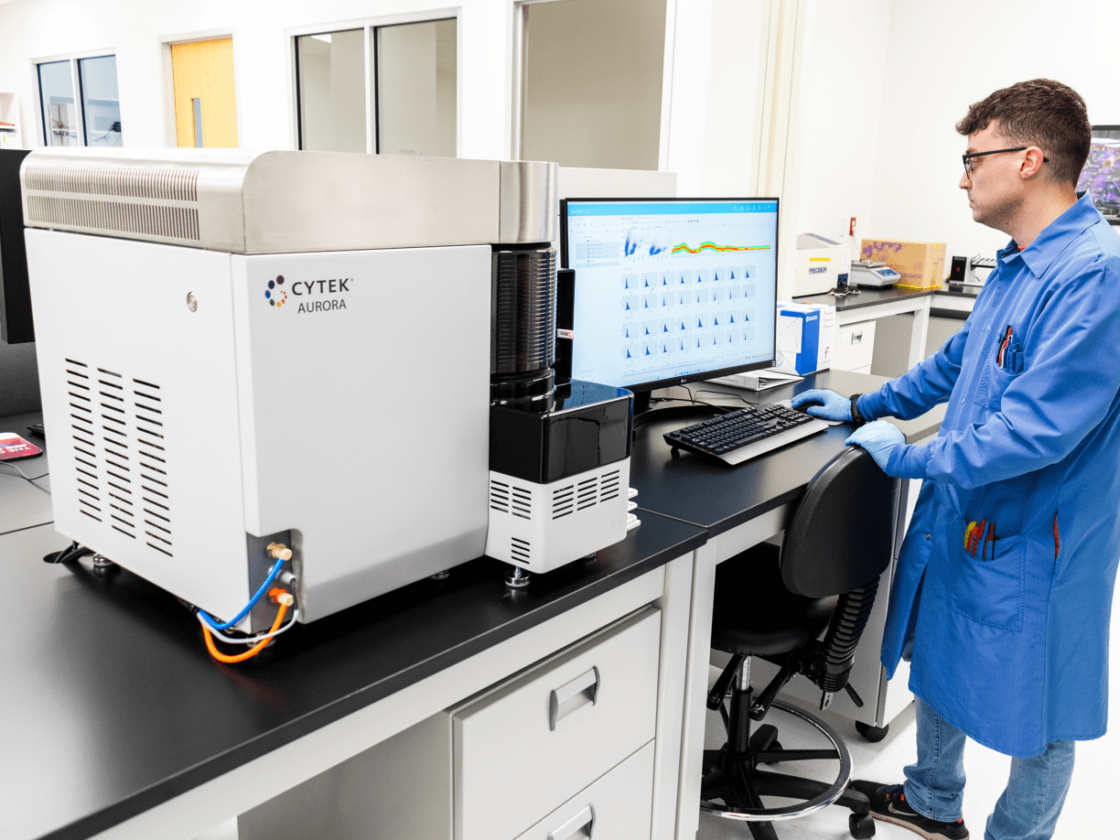
Advancements in spectral flow cytometry have significantly expanded our capabilities – from analyzing a limited number of markers to enabling high-dimensional panels with 40+ parameters. This allows for much deeper characterization of immune cell populations within a single sample.
At the same time, sample preparation remains labor-intensive. To mitigate this, we are implementing automation to improve standardization, increase throughput, and reduce variability which are key factors in large, multi-site clinical trials.
What innovation are you particularly excited about right now?
The development of Receptor Occupancy assays is combining flow cytometry with drug-specific detection to measure how much of a therapeutic is bound to its target receptor on specific cell subsets at a given time. This provides critical insight into drug activity and efficacy, making it highly valuable in early- and late-phase clinical trials.
How do you see your department evolving in the coming years?
As demand for flow cytometry in clinical trials continues to grow, we are expanding our use of automation to support higher throughput. This will also increase the need for advanced data analysis approaches, where artificial intelligence can help manage and interpret complex datasets more efficiently.
Collaboration, Culture, and Scientific Excellence
How does cross-functional collaboration contribute to success at Medpace?
Collaboration across laboratory operations, data management, and project management provides valuable insight into how each function supports the overall study. This allows us to optimize flow cytometry operations and ensure alignment across all aspects of trial execution.
What sets Medpace’s central laboratories apart?
Medpace is large enough to offer deep expertise and high-throughput solutions, yet agile enough to collaborate closely and adapt to Sponsor needs. This flexibility is especially important in complex studies requiring customized assay approaches.
Supporting Sponsors with Advanced Flow Cytometry Capabilities
Medpace’s central laboratories provide Sponsors with comprehensive flow cytometry solutions, supported by experienced PhD scientists, standardized global platforms, and robust assay development and validation processes. From immune phenotyping and rare cell population analysis to advanced applications such as Receptor Occupancy assays, Medpace delivers high-quality, reproducible data tailored to each study’s objectives.
In addition to in-house validated, ready-to-go panels (e.g., TBNK, T-Cell, B Cell, NK Cell, Dendritic Cell, Monocyte, Stem/Progenitor Panel, and PNH), we also offer study-specific fully customized panels with capacity for more than 20 colors. Whether a study requires the development of a custom panel or the transfer of a method, Medpace has the experience to quickly validate and implement flow cytometry testing for your program.