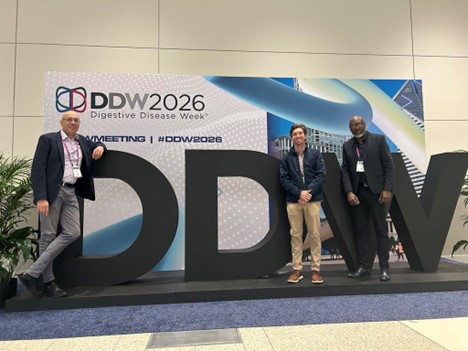
In May 2026, Medpace gastroenterology and operational experts attended Digestive Disease Week® (DDW) – one of the premier international events focused on gastroenterology, hepatology, and endoscopy. Dr. Piotr Krzeski, VP Medical Director and Frénel Joseph, Executive Director, Global Therapeutic Group Lead – GI, share their perspectives on the key scientific and clinical trends emerging from the conference.
A Broader View of GI Innovation
Digestive Disease Week® 2026 reinforced its position as one of the leading global forums in gastroenterology, bringing together clinicians, researchers, and industry leaders across the full digestive disease spectrum. The meeting reflected a clear shift in priorities: beyond novel drug data, there was increasing focus on how to measure disease better, personalize care more effectively, and bring technology into everyday GI practice.
DDW 2026 once again demonstrated its scale and influence as the premier global meeting in digestive health, bringing together more than 13,000 attendees from across gastroenterology, hepatology, endoscopy, and GI surgery. The meeting, held in Chicago from May 2nd to 5th, featured over 4,000 abstracts and more than 400 lecture sessions, underscoring both its scientific depth and broad international reach.
Throughout the event, the Medpace team connected with fellow researchers, site leaders, patient advocacy groups, clients and innovators in GI health. The week fostered collaboration and offered valuable insights into both ongoing challenges and emerging solutions in the field.
What DDW 2026 Signals for the Industry
For industry and clinical teams, DDW 2026 served not only as a scientific conference, but also a major forum for collaboration, data exchange, and clinical development strategy. The combination of large attendance, extensive poster presentation, and high-profile journal publication makes it one of the most important annual touchpoints in GI.
- Scientific breadth was strong, with major attention on IBD, eosinophilic esophagitis, digestive oncology, obesity-related GI disease, and endoscopy innovation.
- Poster and abstract activity was substantial, with an extensive ePoster library and journal-linked abstract supplements published jointly in Gastrointestinal Endoscopy and Gastroenterology.1,2
- Clinical development and translational research remained central, with trial readouts and real-world evidence shaping discussion across multiple therapeutic areas.
- Technology continued to stand out, particularly AI-enabled diagnostics, capsule endoscopy, and robotic or advanced endoscopic systems.
Expert Perspectives from DDW 2026
DDW 2026 highlighted a field that is moving beyond isolated drug readouts and toward a more integrated model of care. Across inflammatory bowel disease, intestinal ultrasound, digital health, endoscopy innovation, and esophageal disease, the meeting showed how clinical development, diagnostics, and technology are increasingly converging.
Inflammatory Bowel Diseases (IBD)
IBD remained one of the strongest scientific pillars of the meeting, with multiple drug programs presented across Crohn’s disease and ulcerative colitis. Key themes included new targeted immunology, durability of response, real-world effectiveness, and how to sequence and combine therapies in patients with or without prior biologic exposure, fistulizing Crohn’s as well as utilization of AI-based technologies in IBD severity assessment or microbiome profiling.
Intestinal Ultrasound and Digital Health
One of the most practice-changing areas at DDW 2026 was the growing role of intestinal ultrasound in IBD monitoring. The meeting and related educational content emphasized its value as a noninvasive, real-time tool for assessing disease activity and treatment response. The broader message is that GI care is moving toward lesser-burden routine practice and a more patient centric approach.
Esophageal and Upper GI Disease
This area remains important because it sits at the intersection of precision medicine and patient-reported outcomes. The focus is not only on symptom control, but also on improving tissue response and endoscopic disease markers with new drugs, drug repurposing and reformulation making notable inroads into the future EoE armamentarium.
Beyond MASLD
Clinical research in hepatology seems to be searching its new challenges, reapplying the learnings from successes and failures in MASLD, with MetALD and ALD appearing as appealing drug development areas over the horizon.
Innovation Accelerates
One of the clearest trends at DDW 2026 was the growing interest in AI-enabled technologies, particularly in image analysis including endoscopy or histology, where innovation is helping ameliorate procedural precision, to improve control and operators’ consistency.
Innovation is no longer just about technical novelty. It is increasingly tied to workflow efficiency, scalability, and the future integration of software, automation, and AI into routine procedures and clinical trials in GI.
DDW 2026 was less defined by a single breakthrough and more by a clear direction of the field. Gastroenterology is becoming more precise, more digital, and more connected across drugs, devices, and data.
For Medpace GI leadership, that makes Digestive Disease Week® especially relevant: it showed where science is going, what Sponsors will need next, and how clinical development must evolve to keep pace. And we look forward to meeting you at DDW 2027.
Supporting Clinical Research Now and into the Future
As GI clinical development continues to evolve, success will depend on aligning scientific innovation with operational execution and real-world evidence. Medpace is the leading GI & Hepatology CRO with experience across Phase I-IV trials, supporting a broad spectrum of indications. As a full-service CRO with a proven track record, we deliver the scientific insight, operational excellence, and flexibility needed to navigate the complexities of each study and accelerate progress for patients. We welcome the opportunity to discuss your upcoming clinical development in gastroenterology and hepatology. Contact our experts today.